CALL: 1 (416) 586 3649



Growing up in Toronto, Canada, where winter is long and cold with skies a sunless grey, I can certainly attest to the effect light has on one’s mood. Research indicates exposure to bright light is “an excellent candidate for inclusion into the therapeutic inventory” (source: Wikipedia), and has been used to treat depression, circadian rhythm sleep disorders, seasonal affective disorders, and a wide range of medical ailments and diseases (see Alzheimer’s disease researchers look to LED lighting). So when I came across a study into LED lighting’s effect on the learning behavior of school children, I wasn’t surprised to learn of a positive effect. What did surprise me, however, was how positive the effect.

A Lighting Designer (LD) uses light to create a desired atmosphere. The light can be artificial or real, practical or purely aesthetic, subtle or intense. The light can evoke an emotion or set a mood. All together, a LD can control 4 properties of light: intensity (brightness of the light), color (temperature of the light), distribution (beam and direction), and movement (change of lighting properties over time).
You can say that LDs are light artistes! But short of tearing down your current lighting installation and erecting their own, how can LD’s communicate their lighting vision to you, the customer, before you commit to build it?

In our previous blog, Are Dimmable LED lamps as Mythical as Unicorns, we examined whether retrofit LEDs can successfully dim using lighting control technology designed for incandescent light bulbs. Due to the continued scrutiny surrounding LED lamp dimmability, today we’re examining another element of LED dimming: leading edge versus trailing edge dimming.

While LED technology is mostly used today as a light source, either on electronic components or as interior or exterior lighting, NASA, in partnership with optoelectronic company, Quantum Devices, Inc., has discovered unique ways to leverage LED technology.
A new study from the Lighting Research Center (LRC) at Rensselaer Polytechnic Institute titled “Field Measurements of Light Exposures and Circadian Disruption in Two Populations of Older Adults,” discovered that individuals with Alzheimer’s disease and related dementias (ADRD) illustrate more circadian disruption than in healthy older adults. The study indicates that a 24-hour light therapy program can boost “circadian entrainment”, thereby improving health and well-being of individuals with ADRD. LED lighting technology can provide the color temperature flexibility required as well as application and form-factor flexibility.

This is a real conversation I had with a friend earlier this week:
Friend: “I want some of your fancy new LED light bulbs for my kitchen.”
Sarah: “What type of lamp?”
Friend: “Lamp? No, I need a light bulb”
Sarah: “The industry refers to them as lamps. It’s a generic term for a device that emits light, regardless of the technology. Whereas the ‘bulb’ in ‘light bulb’ refers to the partially vacuumed glass housing that contains the filament of an incandescent lamp.”
Friend: “OK…so can you get me 6 ‘lamps’ for my kitchen?” (delivered with a hint of sarcasm)
Sarah: “Sure, but what type of lamp?”
Friend: “I’m not following.”
Sarah: “Do you need a PAR lamp, A lamp, MR lamp, BR lamp? What type of base? And is the beam directional or omni-directional?
Friend: “Forget it.”
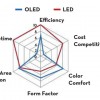
Is the Organic Light-Emitting Diode (OLED) the next big thing in energy efficient lighting? A recent report released by IDTechEx, “OLED vs LED Lighting 2013-2023: Forecasts, Technologies, Players”, determines that while there is great potential, it will be difficult to overthrow LED lighting technology.
COPYRIGHT © 2016 LEAPFROGLIGHTING




