Is the Organic Light-Emitting Diode (OLED) the next big thing in energy efficient lighting? A recent report released by IDTechEx, “OLED vs LED Lighting 2013-2023: Forecasts, Technologies, Players”, determines that while there is great potential, it will be difficult to overthrow LED lighting technology.
When comparing OLED lighting (not OLED displays, which is a separate application) to LED lighting, the IDTechEx report identifies the following three barriers to widespread adoption:
- Cost:
- Materials: For OLED, the encapsulation layers, including desiccant and adhesive, is a main cost driver at $400-$500/m2. The integrated substrate, normally comprised of glass, ITO, metal electrodes, planarization, and external light extraction film, is another large cost driver at $800-$900/m2.
- For OLED at panel level (chip encapsulated, which is to say packaged/assembled) the cost is currently $300-$500/klm. LED luminaries (chip encapsulated) by comparison are currently $20-$100/klm.
- Performance:
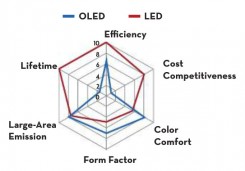
- For OLED (chip encapsulated), efficiency is 20-50 lm/W for OLEDs. LED (chip encapsulated) by comparison is currently 90-100 lm/W.
- For OLED (chip encapsulated), life span is 5,000-15,000 hours. LED (chip encapsulated) is currently 40,000-50,000 hours.
- Benefits/value:
- OLED and LED lighting are both solid state lighting (SSL) technologies that have overlapping value propositions and therefore directly compete over various market segments. LED lighting is a more mature technology with greater performance and market share – so it will be difficult for OLED to gain market control without a strong (and unique) selling point.
source: IDTech EX report
The report states that OLED lighting is not without potential and shouldn’t be dismissed because it’s still in its infancy. According to IDTechEx, OLED lighting has great potential for:
- large-area emission (not realized today because of the limits of the Gen-2 substrate currently being used)
- form factor variety (not realized today due to the rigid glass being used).
- investment and engagement (more companies are actively pursuing the technology and starting to invest)
- reduction in cost for materials and supply chains (OLED lighting can leverage the advances of OLED display technology, which is rapidly advancing)
The report argues that the success of OLED lighting technology depends on companies capitalizing on innovative designs and focusing on fulfilling niche markets where customers are willing to pay a premium price for thin fixtures and glare-free light (ie. hospitality). So although IDTechEx projects the market to grow to 1.3 billion in 2023, they believe the initial market base will be very small (1.3% of the LED lighting market).
To read the full report, see IDTechEx.






Sorry, comments are closed for this post.