CALL: 1 (416) 586 3649


When local business owner Don Monet from Cube Gallery asked if we would participate in NOCTURNE V, an art show and festival dedicated to the night sky, we jumped at the opportunity! As an Ottawa-based company, Leapfrog Lighting is a proud supporter of our local community.
The Wellington Village festival features a “Nocturne” group art exhibit, which includes works from artists, sculptors, scientists, and astronomers who find inspiration in the stars.
The main attraction, which will be attended by Leapfrog, is the street-wide Star Party:
The high cost of electricity—with costs ranging between 6.3 cents and 84.8 cents per kWh—is making the energy-efficient LED lamp a target of thieves, from small single-bulb thefts in hotel rooms to 40,000-bulb robberies.

A question we get asked a lot at Leapfrog Lighting is “How bright is your <x> LED light bulb?”. Our standard response is to cite the number of lumens specific to the lamp in question, or to get more specific, reference the number of lux for a specific distance. But unless the questioner is in the lighting industry, the terms “lumen” and “lux” often lead to confusion.
Manufacturers of the traditional light bulb decided to mass market the term Watts—which actually identifies the amount of power consumed—as a means of describing illuminance level. As a result, most of us are familiar with that metric. So to describe a LED light bulb as providing a certain number of lumens or lux is, well, confusing (especially when a very bright LED light bulb is only 13 Watts!).

The overwhelming consensus from the LED lighting industry is that retrofit linear LEDs—specifically T8s—are a grand misstep; a blight upon an otherwise promising technology.
But are replacement linear tubes getting a fair shake? After all, history tells us that many emerging technologies—now widely adopted—suffered early setbacks and failed to gain initial consumer confidence and industry support. Could this be the same trajectory the retrofit linear LED tube is on?

While energy audits were born out of the energy crisis of 1973, the industry exploded with the current threat of global warming and climate change. The purpose of an energy audit is to identify sources of energy loss in commercial, retail, or residential establishments and provide recommendations for maximizing efficiency and reducing consumption. But are energy audits in retail stores a worthwhile investment? Are these firms overstating their importance or are they providing a valuable service?
While we believe energy audits are valuable, it is important to remember that an auditor’s main goal is to reduce your energy use, not to increase your bottom line of procuring sales.
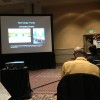
In yesterday’s report we described Lightfair International a “Significant Show Without a Significant Moment.” Not much changes on Day 2 on the floor, although our Leapfrog Lighting team was impressed with some very strong seminars.
It’s worth repeating: lots of activity, plenty of innovation, new manufacturers, great products — but, so far, no breakthrough moment that conference attendees are buzzing. The show continues with record attendance, and is well worth attending, but the main highlight for our Leapfrog Lighting team is an ongoing series of excellent seminars.

Bad news travels much quicker than good news. And in the social media age, it travels lighting fast. A bad product review can do much damage to a company’s reputation, so it makes LED lighting manufacturers a little uneasy when light meters are employed to determine the suitability of their lamps. More >

After hearing various complaints from their readers about LED light bulbs interfering with radio transmissions, Which? Conversation, an online magazine examining today’s consumer issues, decided to conduct their own tests. They found that when they powered on “cheap, generic 12V LED bulbs” located within a “few meters” of a digital radio, the radio signal went fuzzy. Placed within a few centimeters, the signal cut out all together.
While their preliminary test concluded the issue is limited to “cheap knock-offs rather than branded goods”, it is important to identify the reason LED lamps are causing interference. To simply identify the price of a bulb as the culprit is both unsatisfactory and careless. The average consumer targeted by Which? Conversation cannot reasonably assess production and design value of LED lamps. In fact, those types of simple declarative statements (“The energy-saving LED bulb that switched off the radio”) that fail to provide any concrete answers can tarnish the LED lighting industry and impede the widespread adoption of LEDs. Not good.

While in the Northern part of Norway to research the aurora borealis (commonly known as the Northern Lights), Stephen Naor, President of Leapfrog Lighting, discovered that the phenomenon, previously thought of as natural, are actually lit by LEDs, or light emitting diodes. “It’s an incredible discovery “, said a scientist in the field, “Stephen Naor has conclusively determined that the aurora borealis are actually a complex arrangement of LED lights”.
COPYRIGHT © 2016 LEAPFROGLIGHTING




