CALL: 1 (416) 586 3649


According to Lux Research report, Dimming the Hype: GaN-on-Si Fails to Outshine Sapphire by 2020, the market for epitaxial wafers (epi-wafers) LEDs will climb to $4 billion in 2020, but at no thanks to emerging technology gallium nitride-on-silicon (GaN-on-Si).
Most of today’s LEDs are developed using gallium nitride (GaN)-on-sapphire technology (GaN LED grown on a sapphire substrate) while one of the most popular emerging technologies is GaN-on-Si (GaN LED grown on a silicon substrate). The primary appeal of silicon, besides its technological potential, is its nominal cost: silicon is one-eighth the cost of a sapphire substrate.
The Lux Research report concludes that while the choice and cost of LEDs will determine the technology’s level of adoption, this does not suggest GaN-on-Si will emerge the market leader. The report predicts a market share of only 10 percent by 2020 as a result of the technology’s technical shortcomings. One such shortcoming of GaN-on-Si is its tendency to crack due to differences in thermal expansion between the two materials. Cracking ultimately leads to a decrease in efficiency (converting electric current to light). The report further predicts the market for GaN-on-Si will be limited to residential applications, as consumers tend to be more sensitive to cost than performance.
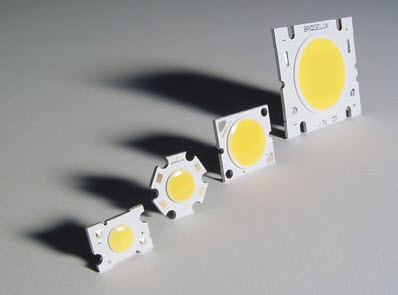
Toshiba and Bridgelux, two companies that partnered together last year to manufacture LED light sources that use silicon, believe that GaN-on-Si is the future—directly contradicting the Lux Research report. Bridgelux predicted in 2012 that they could produce silicon-based LED light sources that generate 1,000 lumens for 50 cents by 2014, which is significantly lower than the cost of GaN-on-sapphire technology today. Bridgelux engineers also say they’ve been able to reproduce eight-inch GaN-on-Si wafers without any cracking—and to the same standards as sapphire (Toshiba, Bridgelux bet on silicon to slash LED lighting prices, CNET).
The Lux Research report paints a dim picture of GaN-on-Si technology, suggesting that advances in sapphire substrate manufacturing technology coupled with new methods of epitaxy (the process of depositing a thin layer on substrate), such as hydride vapor phase epitaxy (HVPE), will “further improve throughput and cut costs, keeping sapphire highly competitive for the rest of the decade.”
The report even indicates that GaN-on-silicon carbide (SiC) will obtain more market share than GaN-on-Si at 18% market share by 2020.
A few points we’d like to highlight:
The future of light emitters is highly competitive and the eventual winning technology has not yet emerged—and indeed may not emerge by 2020—as different emitter technologies will each have their own favored applications.

COPYRIGHT © 2016 LEAPFROGLIGHTING



Sorry, comments are closed for this post.