CALL: 1 (416) 586 3649



With inefficient light bulb bans currently in effect in both the United States and Canada (see The light bulb phase out: USA vs. Canada. Who’s winning? for more information), consumers and businesses alike are scrambling to find suitable replacements. Many mainstream media outlets identify the compact fluorescent lamp (CFL) light bulb as a viable alternative while in the same breath allude to the technology’s reliance on mercury—a powerful neurotoxin labeled a hazardous waste—to operate. However, Light-Emitting-Diode (LED) technology yields a much more capable light bulb, but public knowledge of LED lighting is still very limited. Has the length of time on market and technology familiarity weighed against LEDs as the replacement technology for banned bulbs? Today, we’d like to clear up some of the mysteries of LED lighting—such as the unfamiliar terms and numbers on the box.
According to the Federal Trade Commission, “As of January 1, 2012, all packaging for medium screw base bulbs must include the FTC Lighting Facts label.” As soon as this new packaging entered the market, consumers became confused, as light output or “Brightness” is measured in lumens instead of watts. Traditionally, consumers selected light bulbs based on wattage: A light bulb for a table lamp might be a somewhat subdued 40-Watt bulb, a ceiling light in a bedroom might be a bright 60-Watt bulb, and an outside house light might be an intense 100-Watt bulb. However, in actuality, relating light output to wattage makes little sense. Wattage is an indicator of how much energy the lamp consumes, not how much light it emits.
Here is the Leapfrog Lighting PAR30 3000K LED light bulb box with the FTC Lighting Facts Label. As you can see, this particular light bulb provides 950 lumens of light while using only 12.7 Watts of energy.

So how do you compare lumens to watts even though you can’t technically convert in the same way you can, say, inches to centimeters, since they represent different quantities (luminous flux vs. electric power)? ENERGY STAR has produced a handy chart that outlines the relative equivalency of lumens to watts to ease the transition for the new labeling requirements.
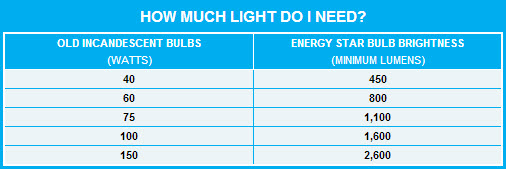
According to this chart, the Leapfrog Lighting PAR30 3000K LED light bulb is equivalent to a ~70 Watt incandescent light bulb.
While the new terms and label might seem confusing, the idea is to help consumers compare various lighting technologies against each other. There are more lighting technologies available today and we can’t continue to use antiquated measurements to get a clear understanding of how a light bulb is going to perform. Soon we’ll forget all about using Watts to identify brightness.
Extra credit: For more in depth technical information about lumens as a lighting measurement, see Illuminating illuminance: lumens and lux and footcandles, oh my!
Now that we’ve covered light output, what about the other non-traditional labels on the box: color quality (measured by the Color Rendering Index), power factor (measured in percent), and light appearance (measured in degrees Kelvin)? Stay tuned next week when we explore each of these metrics so you can choose the right replacement light bulb for your banned incandescent bulb!
Any questions on light output? Ask in the comments box below!

COPYRIGHT © 2016 LEAPFROGLIGHTING



Sorry, comments are closed for this post.