CALL: 1 (416) 586 3649


http://www.prweb.com/releases/2013/4/prweb10666702.htm
Philadelphia, PA (PRWEB) April 24, 2013
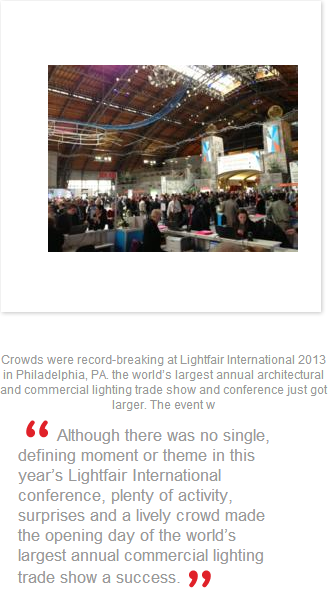
Although there was no single, defining moment or theme in this year’s Lightfair International conference, plenty of activity, surprises and a lively crowd made the opening day of the world’s largest annual architectural and commercial lighting trade show a success. Leapfrog Lighting’s correspondents took in most of the activity of the show, and came away with the impression of a significant event without a significant moment. This can change in the next couple of days, but there was no metaphorical homerun at the show — just plenty of exciting plays.
 Interesting developments included mid-power LEDs — increasingly used in replacement lamps such as A-style and PAR lamps—and new entries into lighting from non-traditional manufacturers. There were some not-quite ready for prime-time plays in the manufacturing of LED A lamps. There were plenty of people moments on the floor, including a woman who lost her collection of balloons when they exploded with a pop on contact with the heat-emitting ceiling halogens. In that moment she probably wished that particular Pennsylvania Convention Center hallway employed the use of LED lamps.
On the first day of Lightfair International, the three notable themes that rose above the busy chatter on the floor were diverse and perhaps trend-setting. The entry of non-traditional manufacturers into lighting was expected but could indicate a new trend. Whirlpool, best known for laundry and kitchen hardware, are now introducing manufactured LEDs. Verbatim Americas LLC, a digital storage solutions company, is now also marketing LEDs and OLED based products.
We saw activity in the mid-power LEDs space. Mid-Power LEDs, typically operating in the range of 0.2W to 1.0W are important to applications such as down-lighting, where greater lumens per watt is critical in a compact package and at an affordable price. With closely-spaced arrays measuring a few millimeters square, arrays of mid-power LEDs provide easier heat extraction due to the increased ability to spread the heat they generate. This in turn simplifies the design of the lamp or luminaire that the LEDs are designed in to.
We also saw a big increase in the number of companies producing LED A lamps. At the show, it was apparent there were two basic designs in A-Lamps. One design sports a central vertical cylinder with between eight and twenty LEDs positioned at the top end of the cylinder, giving light that is well-distributed around the lamp. The other basic design is based on a single upward pointing LED attached to the heat sink, working with an optic that serves to spread the light omni directionally. Of course there are many variations on these designs, but that is the essence of the differences. The developments move in the right direction, but we aren’t calling any clear winners.
And that defines the show. Lots of activity, plenty of innovation, new manufacturers, great products — but, so far, no breakthrough moment that conference attendees are buzzing.
One interesting theme at this show seemed to be lighting control systems. The software focus of the show is new for Lightfair, and lighting control systems and automation played a big role in this area. Lighting control systems include relays, occupancy sensors, light control switches and touchscreen panels—often integrated with other systems such as fire alarms, HVAC and power consumption metering. Hubbel Lighting Inc., Lutron Electronics Co., Encelium, Nextlight Lighting Controls, and Cooper Lighting and Controls were among the many to demonstrate their lighting control systems.
Always a big reason to attend Lightfair International are the seminars and educational opportunities. The Leapfrog Lighting team attended several. “Five Controllable Properties: Resurrecting a 20th Century Assessment Tool for SSL Lighting” — a seminar by Scott Rosenfeld, lighting designer at the Smithsonian American Art Museum and Naomi Johnson Miller, Senior Scientist at Pacific NW National Laboratory”—was well-worth attending, although for the more technically inclined. Math, trigonometry and A/B testing were discussed in the context of optimal lighting. Also discussed were important topics such as phosphors in LEDs that enable us to manipulate color.
Equally interesting was “Lighting for the 21st Century Office” with Wilson Dau, LC, LEED AP, DDCI and Gary Woodall, LEED AP BD+C, LC, IES, IALD, Gary Steffy Lighting Design Inc. The speakers explained, “Workers want comfort, flexibility, and personalization of workspace”, but that the builders “want to meet standards” and have credible and sustainable lighting. Luckily, lighting done right can achieve both. The issues facing office lighting design include less permanent office space, less privacy, and less tradition and consistency. Wilson Dau said that LEDs are ready for large office spaces.
Watch for tomorrow’s reports on Lightfair International, from Leapfrog Lighting Inc.’s correspondents and lighting experts.
Leapfrog Lighting is an innovation leader in LED lamp manufacturing. The current Leapfrog Lighting product line includes MR16, PAR30, PAR38 and PAR20 lamps that provide industry-leading output power through high-efficiency LED source and driver electronics. The innovative lens design creates a pleasing, glare-free light suitable for use in all indoor and unexposed outdoor down-lighting applications. The lamps also deliver the high CRI and ultra-consistent color temperature control critical to multi-lamp applications in hotels, restaurants, schools, office buildings, museums, galleries, retail operations and other public spaces. With a life expectancy of 40,000 operating hours, these UL-registered lamps will provide more than 27 years of service at four hours per day.
COPYRIGHT © 2016 LEAPFROGLIGHTING



Sorry, comments are closed for this post.