CALL: 1 (416) 586 3649


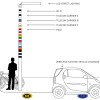
Whether it’s Canadian writer and artist Douglas Coupland’s V-Pole or Philips and Ericsson’s Zero Site street light, the street lighting landscape is undergoing a major change. Yes, the number of urban areas investing in LED street lighting is increasing annually, but no longer are innovators, lighting manufacturers, or urban planners looking at LED street lighting just in terms of energy-efficiency. New proposals and designs are being unveiled to build more efficient urban infrastructures.
How can street lighting help achieve a more efficient city infrastructure? The V-Pole (Vancouver Pole), for example, is designed to provide Wi-Fi for smart phones, tablets, and laptops; multiple telecom carrier services for mobile phones; and electric car charging stations for those non-internal combustion engine automobiles.

Source: v-pole.com
Likewise, the Zero Site street light is designed to include energy-efficient LED lighting and space for mobile operators to rent out and install their mobile broadband infrastructure—a “lighting-as-a-service” operation.
The arguments for these all-in-one street lighting solutions are that they provide:
*Ericsson, The Climate Group, Philips
However, there are also many arguments against these solutions. Potentially the scariest is the idea that specific surveillance functions will be built into LED street lights that will infringe upon the rights of citizens. According to vigilantcitizen.com, the Department of Homeland Security in the United States backs a company named Illuminating Concepts, whose LED street light design includes a “speaker system, motion sensors, video cameras, and mics”.
Many are also concerned about the monopoly that telecom companies will have over any given city. This argument is well conveyed by senior writer of GigaOM, David Meyer, about the Zero Site street light: “…one telecoms supplier’s equipment would be embedded into the very fabric of the city in such a comprehensive way, with the lampposts themselves designed to hold Ericsson base stations. Wouldn’t it risk locking cities—and indeed the carriers operating in those cities—into using Ericsson and Philips for a long time?” (gigaom.com).
In New York, Councilman Peter Vallone is concerned about health issues from cell antennas as a result of the Department of Informational Technology and Telecommunication’s smart street lights agreement to fit 18,000 lamp posts with cellular and high speed Internet antennas. Vallone is calling for radiation inspection to be paid for by the telecom companies.
What are your thoughts? Should street lights remain focused on becoming only more energy efficient and safe by utilizing LED technology, or should they be used to build more efficient urban infrastructures as well?

COPYRIGHT © 2016 LEAPFROGLIGHTING



The con-arguments quoted by you represent valid concerns, but they can be addressed and solved in a way for all acceptable. It would be, IMHO, beneficial for all to use the already existing lamp posts in multiple ways, by that reducing the costs and give the citizens more acceptable and reliable street lights.
The just closed ‘Guangzhou International Lighting Exhibition’ did show an ever widening variety of lighting controls, offering the possibility to save more energy without reducing the quality of life for the users, in many cases even improving it. It can be expected, that light itself will be used in the not so distant future to transmit data. With that already the concerns related to too much electromagnetic radiation would be addressed