CALL: 1 (416) 586 3649


The sub-$10 LED A-shaped light bulb. First Cree and now Walmart. GE is following in close pursuit. And, after spending days wandering through row upon row of LED manufacturers at Hong Kong Lightfair last week, it sure seems as though the market will be saturated with single digit-priced LED bulbs from many other players before too long. The adoption of LED bulbs is said to be slow due to the high cost of the technology, especially in comparison to other existing – and dependable – lighting technologies. So to remove that hurdle, it seems like the race is on to find the price point that is acceptable to the general population. But are these sub-$10 LEDs that are currently hitting the market also sub-standard in performance? Are they helping or hurting the LED lighting industry?
Market share is extremely important in this overcrowded industry, and being first to market with an affordable (ie. low cost) solution is an easy way to gain market traction. But the sub-$10 bulb arrived quicker than many anticipated. While material costs and manufacturing costs have decreased, and light bulb design has improved to produce more reliable and efficient bulbs, the price drop was significant over the period of just one year.
So the question is: are LED manufacturers trying to gain market share by lowering prices—regardless of the actual cost to manufacture? Or are manufacturers trying to gain market share by using lower quality components and manufacturing along with scaled back design? Or have some manufacturers figured out a way to put out a quality product at an attractive price and net a healthy profit? Or perhaps it’s somewhere between all three?
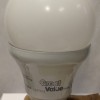
We’ve read several reviews on the Walmart Great Value LED bulb, made by TCP Lighting in China and have tested it in our lab. While we do not claim that the Walmart Great Value LED is representative of all sub-$10 LEDs on the market today, we believe it does give some insight into whether or not today’s sub-$10 bulbs are indicative of a promising direction for the industry.
Here are the specifications listed on the Lighting Facts label for the Walmart Great Value 60-Watt equivalent, dimmable, soft white (2700K) and daylight (5000K) LEDs:

Note Walmart’s use of the less informative of the two Lighting Facts labels (Federal Trade Commission’s label which Walmart uses vs. Department of Energy’s). Even though use of the Department of Energy’s (DoE) label is voluntary, the rules that back the specifications printed on the label are much more rigorous, as use of the DoE’s label requires LM-79 testing. The label must also list Color Rendering Index (CRI) and luminous efficiency, not required by the Federal Trade Commission’s label.
We conducted abbreviated LM-79 tests on the soft white and daylight Walmart Great Value LED 60-Watt equivalent dimmable light bulbs. We can confirm that upon our initial testing, the bulbs did live up to the specifications listed on the box (light output and energy used). In fact, the soft white bulb produced light output approximately 10% better than specified and the daylight bulb was even better than that. Energy use was slightly lower than 10.5 Watts, which is better than the 11 Watts specified on the Lighting Facts label. In our testing, the initial CRI came in around 83, a very acceptable number for most purposes. We found no issues with the beam pattern. These test results all bode well for these bulbs, however we do not yet have any indication as to how they will perform over time.
The design uses very few parts and there is no traditional heat sink. As a side note, this type of design was prevalent at Hong Kong Lightfair.

On the Walmart.com site, reviews are largely positive, with a few comments about the base getting extremely hot. Perhaps the design without a traditional heat sink is causing this? Heat sinks play an important role in the lifetime of LEDs (note only a 25,000h lifetime for this product). The warranty is 3-year limited based on 3-hour per day use.

Dropping the cost of LED bulbs is certainly what consumers want—but not if it comes at the price of overly reduced light quality and reduced general performance.
If consumers purchase a low-cost LED light bulb and it fails to perform as expected, does it hurt the LED lighting industry? And if LED manufacturers with better-performing products are forced to lower their prices to compete, how can the average consumer make a qualified decision as to which light bulb is superior if the costs are similar? As we’ve seen many times with LED light bulbs, a well-known brand doesn’t necessarily equate to quality.
What do you think about the sub-$10 LED light bulb in 2013? Is it hurting or helping the LED lighting industry? Will it increase adoption of LED lighting technology?
We asked that question in our October 2013 newsletter. Before we tabulate the results, we’d like to open this up to a wider audience. Vote now!

COPYRIGHT © 2016 LEAPFROGLIGHTING



A “heat sink” doesn’t have to look like a heat sink; it functions by having sufficient area exposed to air. This smooth lower section is the lamp’s heat sink, and by the reports of users it sounds like a minimal design.
The lamp turning off (flickering, then cutting off) indicates the thermal overload in the driver was reached.
Overall, it sounds like a design where too many corners were cut.
-The TCP A-19-
This wasn’t the first sub $10 LED A lamp I ‘ve gotten – It’s just another rather
mediocre product. My experience was that it had flaws, a minimalist warranty, so- so
photometry and it’s acquistion was helping 2 firms I have low regard for-
take my advice go blow the $9 on a nice lunch – or keep searching for a better SSL product,
which may entail spending more money per a unit – but will yield a better quality of light over
years not just seasons.-
Also if you wanted more information about this TCP product Margery Conners did a nice teardown
evaluation on this one- it points out some of the lamps defeciencies and how it’s constructed.
Ultimately – LED lamps that are like these “replacements ” will cost as little as $2 or $3 soon – so while the passing
of the sub ten dollar retail price point is noteworthy – the TCP lamps’ performance or desirability isn’t !
Of course thats one mans opinion – it’s just that the guy doing the opining knows a little bit about LED lighting –