Recently, Stephen Naor (President, Leapfrog Lighting) and I went to Hong Kong to attend Lightfair, a huge annual lighting show with companies from all over the word exhibiting their latest and greatest lighting products. After examining the products of almost all 2,170 exhibitors—who were spread over 100,000 square meters and 5 floors—we discovered a lot more than just the value of comfortable shoes.
What did we discover?
- Very few companies are showing compact fluorescent light (CFL) bulbs. In fact, 3 of the 5 floors were dominated by light-emitting diode (LED). LED is clearly the new lighting product. Advances in technology are improving the quality of LEDs while simultaneously decreasing costs. Along with all the other advantages of LEDs over CFLs (see 5 reasons why LED lamps are better than CFLs), interest in, and adoption of, LEDs is catapulting.
- Very few companies are manufacturing PAR and A lamps that are distinguishable from one another. There were a few new and interesting innovations, but on the whole vendors are offering very similar products in terms of design and performance. Massive industry attention to cost is the culprit, the by-product of which is loss of innovation. Is this is blessing or a curse? Read Stephen’s blog, “Me Too” products rule Hong Kong’s Lightfair, to find out.
- Very few companies are manufacturing UL-approved bulbs. Instead, most bear the CE mark, which identifies a product as complying with the health and safety requirements set out in Europe. At first blush this might seem acceptable based on market volumes (27 member states of the EU, plus Iceland, Liechtenstein, and Norway). But it is important to note that CE qualification has lesser requirements on the protection against failure in the power supply, making it easier to get products qualified. Additionally, because the EU has legislated quite aggressively for incandescent replacement, vendors are trying to supply the market as fast as possible by putting out simpler and cheaper bulbs – many of which would not qualify for the UL mark. What does this mean for consumers? It removes piece of mind and confidence, as bulbs without the UL mark are not held to the same high standards and regulations. For more information about UL, see LED lamps and UL certification.
- Upward trend in manufacturing ceramic PAR and MR lamp heat sinks (and also thermoplastic for MR). While this lowers the weight of the bulb, providing savings (shipping costs and C02 footprint) and greater installation flexibility (not all fixtures deal well with heavy components), there is a downside: inferior thermal performance. The ceramic, called alumina, is about 1/6th the thermal conductivity of aluminum and the best thermoplastics are about 1/10th. Inferior thermal performance negatively impacts the efficiency and light output of the lamp. Simply stated, a cooler LED is more efficient, but this is a trend we’re watching closely. LED performance continues to improve, which means at the right time these sorts of solutions will move into the mainstream rather than just the lower power lamps as at present.
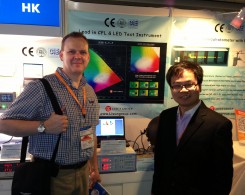
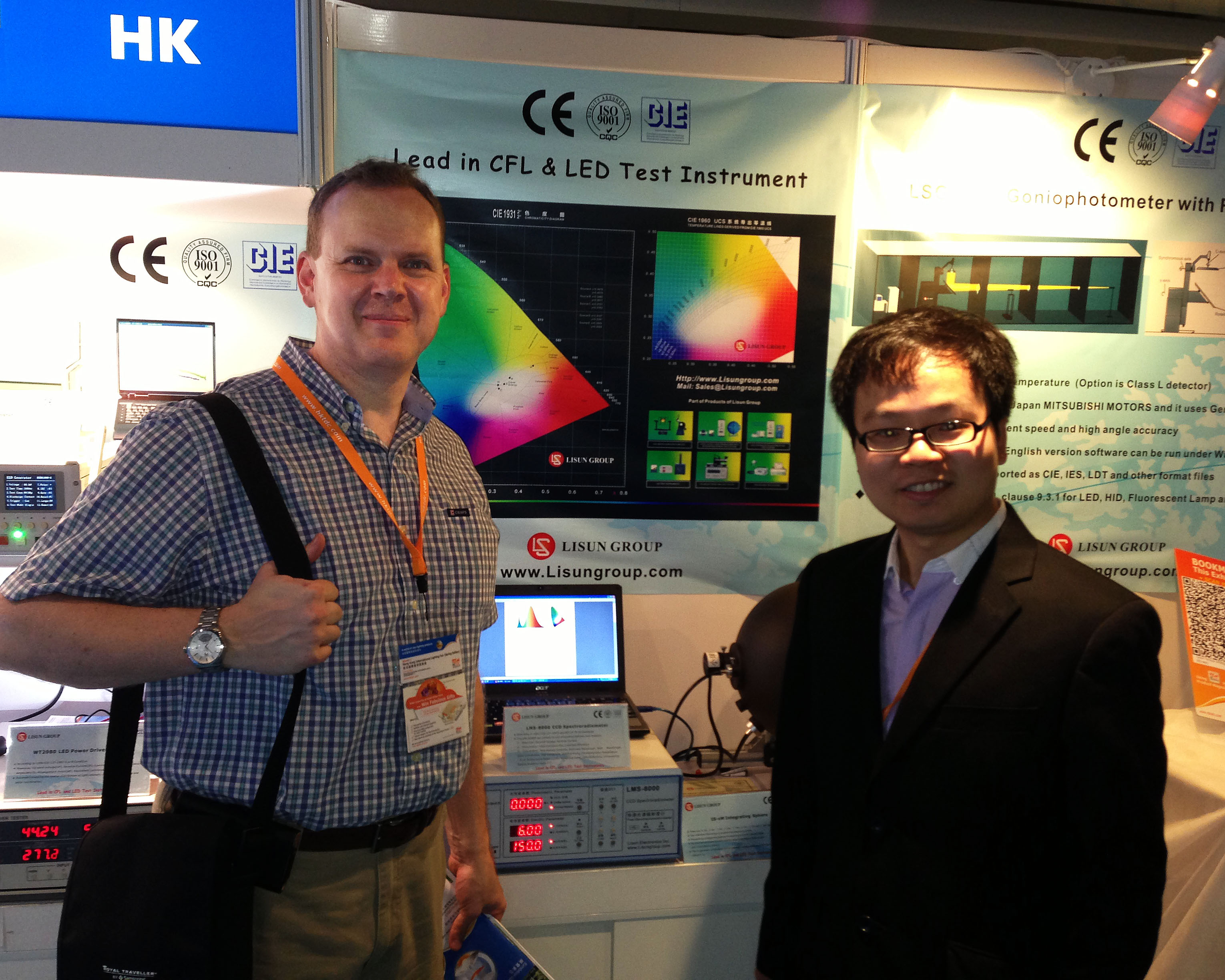
Chris Hart and vendor at Hong Kong Lightfair (Oct 2012)
If you’re curious about any other aspect of the show, let me know!





Wouldn’t be so bad but CE is a self certification process and means very little. Unless these ‘Me too’ manufacturers deliver cost saving or genuine performance against the others out there they will soon fade away to leave those who have invested in technology advancement or production capabilities.